
Science · Chemistry · Food preservation and dehydration chemistry
Food that outran refrigeration
How pemmican used chemistry barriers to stay shelf-stable on long journeys.
Nations / communities: Métis, Plains Cree
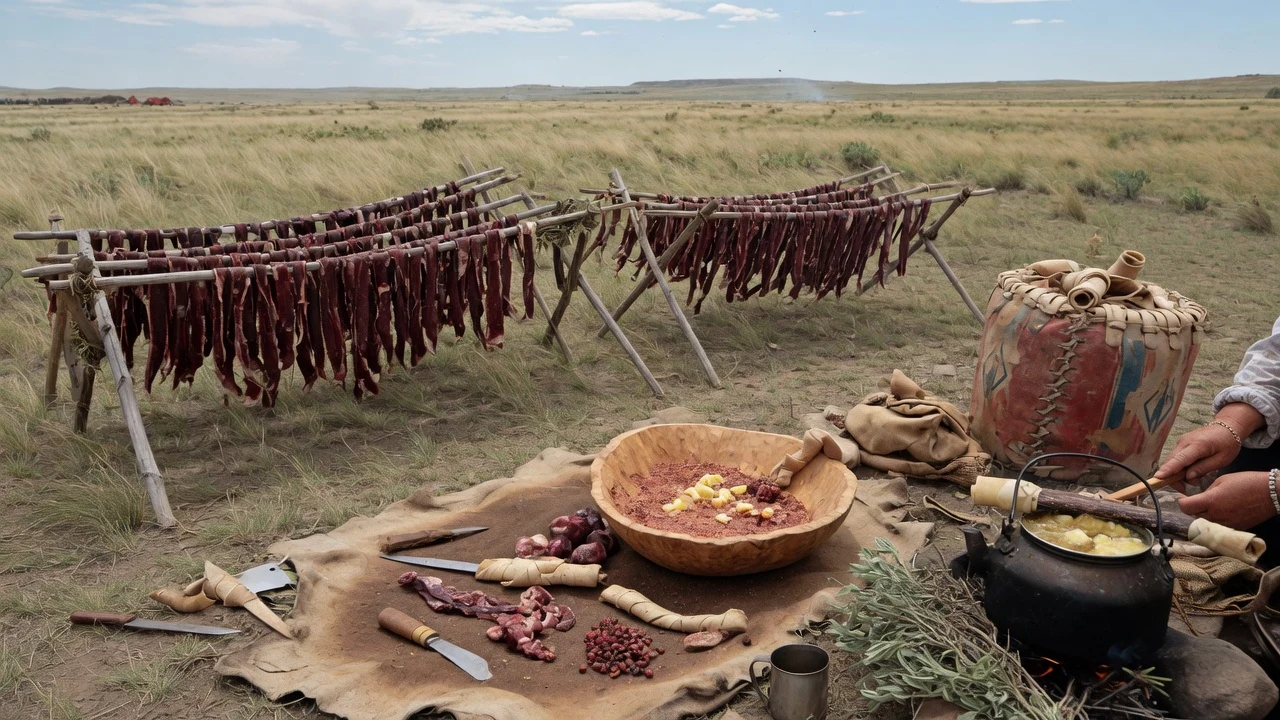
The preservation challenge
Food needs to survive heat, cold, handling, and weeks of travel with no refrigeration.
The chemistry approach
Microbes need available water and favorable reaction conditions. Pemmican removes both.
- Dry the meat: evaporation drops water activity (a<sub>w</sub>).
- Powder it: uniform particles for consistent fat coating.
- Render fat: separates usable lipid through phase change.
- Coat particles in fat: blocks oxygen and moisture at surfaces.
- Pack in rawhide: limits exposure during transport.
This is hurdle preservation: multiple barriers that compound.
What this demonstrates
This is food chemistry using land-based tools: phase change, moisture control, surface area management, and barrier packaging. The variables food scientists measure today were being controlled on the Plains before lab equipment existed.
Summer hunt timing reflects applied chemistry — reliable sun and wind maximize evaporation rates.
Discussion prompts
Paired insert: Open The 90-pound food battery that powered the plains to connect shelf-life chemistry to human energy needs.
Discussion prompts
- Which preservation barrier matters most here: low water, fat coating, or tight packing? Defend your answer.
- Predict failure modes: what goes wrong if one step is skipped?
- Why is particle size control a chemistry advantage?
- Where do you see the same preservation logic in modern packaged foods?
References
External sources — not hosted by Lesson Basket. Links open in a new tab.
- Food drying — Wikipedia (overview)
Dehydration inhibits microbes by removing water; useful classroom overview.
- Drying foods — National Center for Home Food Preservation
University extension source on dehydration preservation principles.
- Pemmican — The Canadian Encyclopedia
Traditional preparation sequence and storage.
- Pemmican Proclamation — The Canadian Encyclopedia
1814 seizure of preserved food — supply-chain politics.
- HBCA Spotlight: Seven Oaks
Primary documents on pemmican columns and provisions.
- Saskatchewan Chemistry 20 curriculum
Official SK Chemistry 20 outcomes for unit alignment.