
Science · Biology · Classification, adaptation, and camouflage
Outsmarting a 900-kg herd
How adaptation science and ecological intelligence shaped Plains hunting strategy.
Nations / communities: Métis, Plains Cree, Piikani (Blackfoot Confederacy)
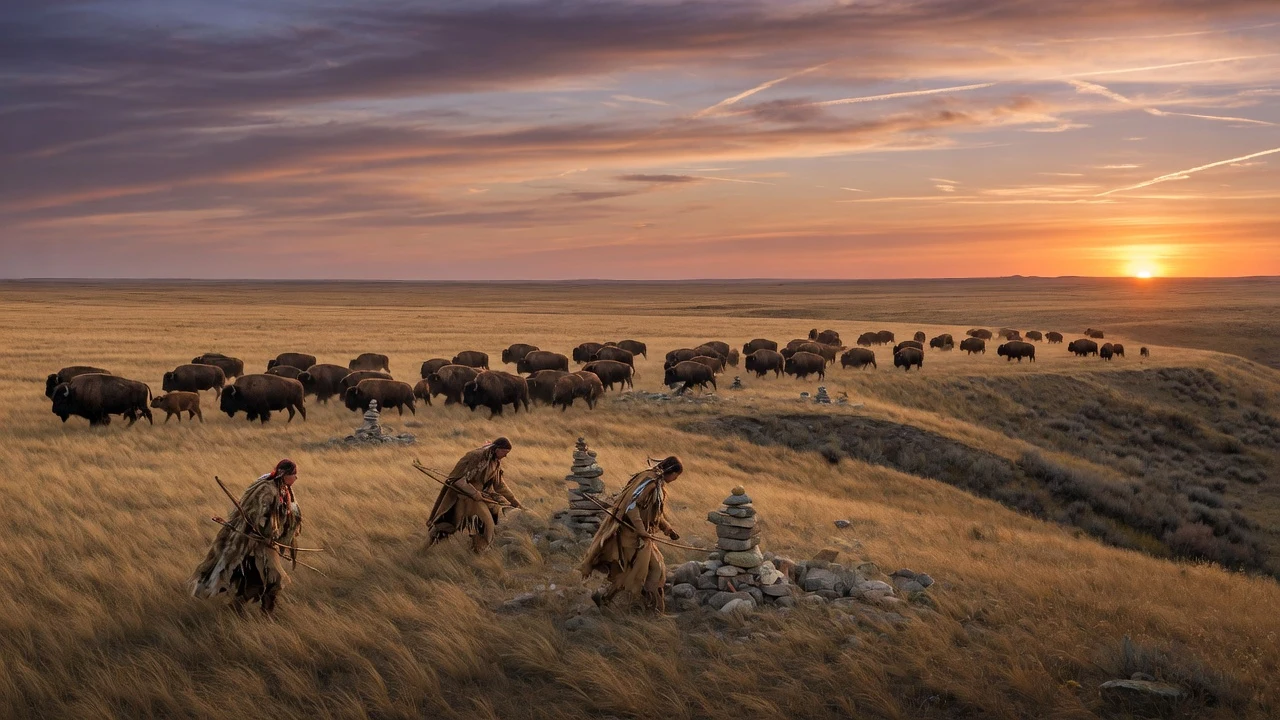
The hunting problem
How do you approach a massive, fast, herd animal in open grassland?
The biology
In predator-prey systems, each side responds to the other over time.
- Bison traits: strong smell, herd defense, predictable movement.
- Human response: camouflage, mimicry, terrain use, coordination.
That is adaptation pressure in action.
Plains implementation
Plains hunters used ecological observation and strategy.
- Disguise and background matching: hides or winter robes reduced visual contrast.
- Behavioral mimicry: calf calls triggered protective movement.
- Wind and scent control: movement respected what bison could smell.
- Buffalo jumps and pounds: landscape-scale systems using cairns, runners, flankers, and terrain.
- Tracking: stride, depth, and pattern in snow or ground provided field data.
This is field biology, engineering, and coordinated teamwork.
What this demonstrates
Hunting strategy worked because it matched animal behavior, environment, and planning. The same variables ecologists study now were being applied on the Plains for generations.
Discussion prompts
Discussion prompts
- If you had one advantage to exploit (smell, sight, herd behavior), which would you pick and why?
- Build a cause-and-effect chain: bison trait -> hunter response -> expected outcome.
- Why is a buffalo jump better understood as a designed system, not a location?
- What is the difference between biological evolution and human tactical adaptation?
References
External sources — not hosted by Lesson Basket. Links open in a new tab.
- Head-Smashed-In Buffalo Jump — UNESCO
World Heritage site; communal hunting and landscape engineering.
- Buffalo Tracks (PDF) — Head-Smashed-In Buffalo Jump
Stalking disguises, drive lanes, surround, and pound techniques.
- Bison Bellows: Indigenous Hunting Practices — U.S. National Park Service
Decoy runners, wolf-skin tactics, and communal hunt methods.
- Tracking, an Ancient Science (PDF) — Alberta Parks
Track measurement and Traditional Ecological Knowledge framing.
- Buffalo Hunt — The Canadian Encyclopedia
Plains-wide practice; Métis and First Nations contexts.
- Buffalo & the Plains Indians Education Kit (PDF) — South Dakota State Historical Society
Hide use, disguise hunting, and respectful classroom framing.