
Science · Physics · Heat transfer, insulation, and convection
No furnace. No fan. Still warm.
A Plains tipi solves smoke, wind, rain, and −40 cold — with nothing but poles, hide, and smart air flow.
Nations / communities: Plains Cree, Nakoda, Saulteaux, Dakota, Lakota
January on the open prairie. Wind, no power, no furnace. Your family needs a warm, dry place tonight — and you might move camp in two weeks.
How do you not freeze, not choke on smoke, not get soaked when it rains, and not have your shelter blow away?
Plains Nations solved this with the tipi (thípi) — a portable lodge that works as a climate machine. No motors. Mostly air doing the work.
Look at the cutaway below. Every arrow is a design choice refined through generations.
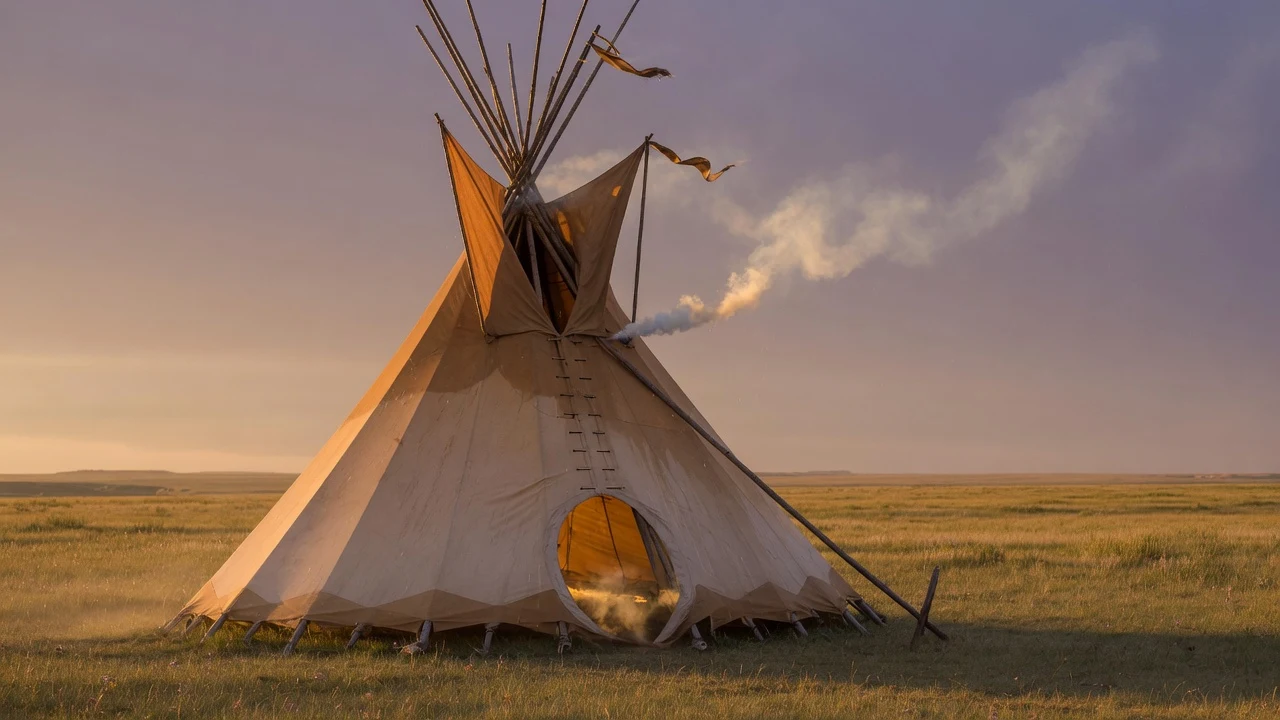
The engineering challenge
You need one shelter to do five jobs at once:
- Keep people warm.
- Move smoke out.
- Stay stable in prairie wind.
- Keep rain out.
- Pack up and move.
That is a systems design problem.
What the design solves
A Plains tipi uses geometry and airflow to self-regulate.
- Fire + smoke hole: hot air rises and exits.
- Low intake path: cooler air enters below and feeds a convection loop.
- Inner liner gap: supports ventilation and insulation, depending on setup.
- Smoke flaps: tuned to wind direction to maintain draft.
- Cone shape: resists wind better than flat walls.
Climate control without motors.
The science
The same vocabulary your unit uses appears here in a working system:
- Radiation: heat from fire to people/surfaces.
- Convection: moving air loop carrying heat and smoke.
- Conduction: heat through solids like poles/ground.
- Insulation: trapped still air reducing heat loss.
What this demonstrates
This is iterative engineering refined through observation and practice across generations. Many of the same principles show up in modern HVAC and cold-weather architecture.
Discussion prompts
Discussion prompts
- Which one design choice here has the biggest effect on smoke removal, and why?
- Trace the full convection loop on the diagram, then predict what changes on a calm vs windy day.
- How can one liner gap support both ventilation and insulation?
- If smoke flaps are misaligned, what failure chain starts first?
- Compare one school building feature (vent, return, insulation layer) to the equivalent tipi function.
References
External sources — not hosted by Lesson Basket. Links open in a new tab.
- Teaching about Tipi Technology — State Historical Society of North Dakota
Museum educator source on liner chimney effect, insulation, aerodynamics, and rain management.
- Cultural STEM Kits — Actua InSTEM
Indigenous STEM framing: tipi design linked to convection, heat transfer, and insulation.
- Gr K-12: The Tipi — Royal Saskatchewan Museum
Saskatchewan museum learning resources and tipi construction context.
- Tipi Sleepovers — Wanuskewin Heritage Park
Saskatchewan heritage site; Plains Cree tipi teachings.
- Inside Our Tipi — Glenbow (Blackfoot exhibition, archived)
Liner ventilation, smoke-flap draft control, and rain protocols — Blackfoot voice.
- Saskatchewan Indigenous Cultural Centre (SICC)
Authoritative context for Saskatchewan Nations and languages.